
knee pain treatment in Markham
knee pain, patellofemoral pain syndrome and iliotibial band syndrome: causes, chiropractic treatment and prevention
Struggling with knee pain in Markham?
Knee pain can limit your ability to stay active, exercise and even perform everyday tasks like walking or climbing stairs.
At in balance chiropractic + acupuncture clinic, we offer chiropractic care for knee pain and joint dysfunction, to reduce pain, restore movement and improve long-term joint health.
Whether your pain is from running, sports, overuse, or injury, we focus on identifying the root cause — not just treating symptoms.
Quick guide: knee pain
Condition:
Knee pain can result from ligament strain, tendon irritation, cartilage wear, joint inflammation, or poor biomechanics affecting the knee joint.
Common symptoms:
- pain around or behind the kneecap
- outer or inner knee pain
- swelling or stiffness
- clicking, popping, or grinding
- instability or “giving way”
- pain with walking, running, squatting, or stairs
Common causes:
- overuse or repetitive strain
- sports injuries
- muscle imbalances
- poor alignment or movement patterns
- arthritis or joint degeneration
Treatment options:
- chiropractic care and joint mobilization
- soft tissue therapy (ART, fascial abrasion)
- acupuncture
- exercise rehabilitation,
- biomechanical correction (orthotics)
- activity modification
When to seek care:
- if knee pain lasts longer than 1–2 weeks
- causes swelling or instability
- interferes with walking, sports, or daily activities
Understanding knee pain
The knee is a complex joint that absorbs significant force during walking, running, and jumping. Because of this, it is highly vulnerable to stress, overuse, and injury.
Knee pain may develop gradually from overuse, repetitive strain or muscle imbalance or occur suddenly after sports injury or trauma. In many cases, the root cause isn’t just the knee — it may involve the hips, pelvis, or feet affecting overall movement patterns.
A proper assessment helps identify the true source of pain so treatment can be targeted effectively.
Symptoms of knee pain
Knee pain can present in several different ways depending on the underlying cause. Common symptoms include:
- pain around the kneecap or behind the knee
- pain on the inside or outside of the knee
- swelling or inflammation around the joint
- stiffness or reduced range of motion
- clicking, popping, or grinding sensations
- a feeling of the knee “giving way” or instability
- pain with walking, running, squatting, or climbing stairs
- pain after prolonged sitting or inactivity
Common causes of knee pain
Knee pain often develops due to a combination of factors, including:
- weak hip and gluteal muscles
- tight quadriceps, hamstrings, or IT band
- poor biomechanics or alignment
- sudden increases in activity or training
- improper footwear
- repetitive stress (running, jumping, sports)
Common knee pain conditions
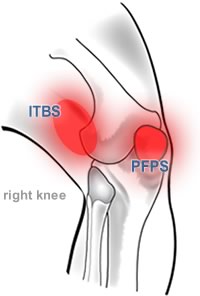
Two of the most common conditions we treat in our Markham clinic are Patellofemoral pain syndrome and Iliotibial band syndrome.
These conditions are especially common in runners, cyclists, and individuals who perform repetitive knee bending.
Patellofemoral pain syndrome (runner’s knee)
Patellofemoral pain syndrome occurs when the kneecap (patella) does not track properly within the femoral groove. This often results from muscle imbalances in the quadriceps, hamstrings, and gluteal muscles.
Common contributing factors include:
- weak hip or gluteal muscles
- tight quadriceps or hamstrings
- overuse from running or jumping
- poor biomechanics or alignment
- improper footwear
This condition typically causes pain around the kneecap, especially with stairs, squatting, running, or prolonged sitting.
Iliotibial band syndrome (ITBS)
Iliotibial band syndrome occurs when the iliotibial band — a thick band of connective tissue running along the outer thigh — becomes tight and rubs against the outer portion of the knee.
This repetitive friction can cause inflammation and pain along the outside of the knee.
Common contributing factors include:
- tight iliotibial band
- weak hip stabilizing muscles
- sudden increases in training intensity
- poor running mechanics
- running on sloped surfaces
Other knee injuries include:
Meniscus injuries
The meniscus is a crescent-shaped cartilage structure that acts as a shock absorber between the thigh bone and shin bone.
Meniscus tears are common in athletes but can also occur with simple twisting movements, especially in older adults.
Typical symptoms include:
- pain along the joint line of the knee
- swelling after activity
- catching or locking of the knee
- difficulty fully bending or straightening the knee
Ligament sprains
Ligaments stabilize the knee joint. Sudden twisting, pivoting, or impact injuries can stretch or tear these ligaments.
Common knee ligament injuries include:
- ACL (anterior cruciate ligament) sprains
- MCL (medial collateral ligament) sprains
- LCL (lateral collateral ligament) sprains
Symptoms may include swelling, instability, bruising, and difficulty bearing weight.
Knee osteoarthritis
Osteoarthritis is a degenerative condition in which the cartilage within the knee joint gradually wears down over time.
It is more common in adults over 40 but may also develop after previous knee injuries.
Symptoms often include:
- deep aching knee pain
- stiffness after rest or in the morning
- swelling or joint enlargement
- grinding or creaking sensations during movement
Other conditions that may cause knee pain
Knee pain may sometimes be influenced by issues elsewhere in the body, including:
- hip muscle weakness or imbalance
- foot mechanics such as overpronation
- tendon irritation (patellar tendonitis or “jumper’s knee”)
- bursitis around the knee joint
Proper evaluation helps determine which structures are contributing to the pain.
Knee pain – who this care is for
Our knee pain treatment in Markham is ideal for patients who:
- have pain with walking, running, or stairs
- experience recurring knee injuries
- have been diagnosed with runner’s knee or IT band syndrome
- notice stiffness, swelling, or instability
- want to return to sports or exercise safely
Effective treatments for knee pain
At in balance chiropractic + acupuncture clinic, we take a comprehensive, whole-body approach to care — addressing not just the knee, but the entire kinetic chain.
A combination of therapies often produces the best results.
Key treatment approaches
Chiropractic care
Adjustments and joint mobilizations to the pelvis, hips, and knees can help restore proper alignment, mobility and movement patterns.
Soft tissue therapy
Techniques such as Active Release Techniques (ART), fascial abrasion technique (FAT), and cupping therapy help release tight muscles and break down adhesions.
Acupuncture
Acupuncture can help stimulate blood flow, reduce muscle tension, and promote tissue healing.
Exercise rehabilitation
Targeted stretching for the quadriceps, hamstrings, glutes, and iliotibial band improves flexibility and reduces tension around the knee.
Strengthening exercises target weak muscles that contribute to poor knee mechanics.
Common exercises include:
- side-lying leg lifts
- clamshells
- hip bridges
- terminal knee extensions
Foam rolling
Self-myofascial release using foam rollers can reduce tightness in the iliotibial band and surrounding muscles.
Kinesiology taping
Taping techniques may help support the knee joint and improve muscle activation during activity.
Custom orthotics
Orthotics support proper foot mechanics and reduce abnormal stress on the knee joint during walking or running.
Why early treatment for knee pain matters
Ignoring knee pain can lead to chronic inflammation, compensation patterns, and more serious injury over time.
Early treatment combining manual therapy, exercise rehabilitation, and biomechanical correction can:
- reduce pain and swelling
- improve joint mobility and muscle strength
- improve biomechanics
- prevent recurring knee injuries
- support long-term joint health
If you are experiencing knee pain from running, sports, or daily activities, a personalized treatment plan can help restore pain-free movement and improve long-term joint health.
At in balance chiropractic + acupuncture clinic in Markham, patients from across York and Durham Region frequently seek care for knee injuries, pain, and biomechanical imbalances affecting the knee joint.
Related conditions and contributing factors
Knee pain is often influenced by surrounding areas such as the hips and feet due to hip weakness, issues with foot mechanics and ankle instability. Some patients may also benefit from:
FAQs about knee pain in Markham
Knee Pain
Yes, custom orthotics can help reduce knee pain, particularly when the pain is related to poor foot mechanics.
If the feet excessively roll inward (overpronation) or outward (supination), it can change the alignment of the ankle, knee, and hip. Over time, this can increase stress on the kneecap or the iliotibial band.
Custom orthotics help by:
- improving foot and ankle alignment
- supporting the foot arch
- reducing abnormal stress on the knee joint by reducing excessive inward rolling of the foot
- improving overall biomechanics during walking or running
Many patients with PFPS or IT band syndrome experience improved comfort and performance when orthotics are combined with strengthening exercises and chiropractic care.
Recovery time for iliotibial band syndrome varies depending on severity and how early treatment begins.
Most mild to moderate cases improve within 4–8 weeks with proper treatment and activity modification.
Key steps for recovery include:
- stretching the IT band, quadriceps, and glutes
- strengthening the hip stabilizing muscles
- foam rolling the outer thigh
- reducing high-impact activities temporarily
- addressing biomechanical issues such as poor running form
Early treatment often leads to faster recovery and reduces the risk of chronic knee pain.
Pain on the outer side of the knee during running is commonly caused by iliotibial band syndrome (ITBS).
This occurs when the iliotibial band — a thick connective tissue running from the hip to the knee — becomes tight and rubs against the outer part of the knee joint.
Common contributing factors include:
- weak hip stabilizing muscles
- tight iliotibial band or quadriceps
- running on sloped surfaces
- sudden increases in training intensity or distance
- poor footwear or worn-out shoes
Tip for runners:
Gradually increase mileage and include hip strengthening exercises to reduce stress on the knee.
The fastest way to reduce patellofemoral pain syndrome (PFPS) symptoms is to temporarily reduce aggravating activities such as running, deep squatting, or stairs as a first step.
Additional strategies include:
- avoid sitting with knees bent for long periods
- ice for 10–15 minutes after activity
- strengthen the gluteal, quadricep and hip muscles to improve knee alignment
- gradually return to activity rather than pushing through pain
Chiropractic care and soft-tissue therapies can also help reduce muscle tension and improve kneecap tracking. Patients often find that combining exercise therapy with hands-on care helps them recover more quickly and prevent recurrence.
You should consider seeing a chiropractor if knee pain:
- persists longer than 1–2 weeks
- occurs regularly during exercise
- causes swelling, weakness, or instability
- prevents you from walking, running, climbing stairs, or squatting comfortably
Knee pain treatment in Markham
Knee pain can impact your ability to stay active and enjoy daily life. At in balance chiropractic + acupuncture clinic, we offer chiropractic care to help you recover from knee pain, sports injuries, and biomechanical dysfunction.
Our clinic sees patients from Markham, Cornell, Unionville, Stouffville and across York and Durham Regions, seeking care for running and sports-related injuries, to osteoarthritis pain to biomechanical imbalances contributing to other types of knee pain.
Our goal is simple:
Get you out of pain, moving better, and back to doing what you enjoy.
Book your appointment today and discover how your in balance chiropractor can evaluate the entire kinetic chain — including the feet, knees, hips, and pelvis — to identify the underlying cause of your knee pain and help you restore pain-free movement.
